Free, confidential whistleblowing advice
Call us on 020 3117 2520 or email us

Free, confidential whistleblowing advice
Call us on 020 3117 2520 or email us

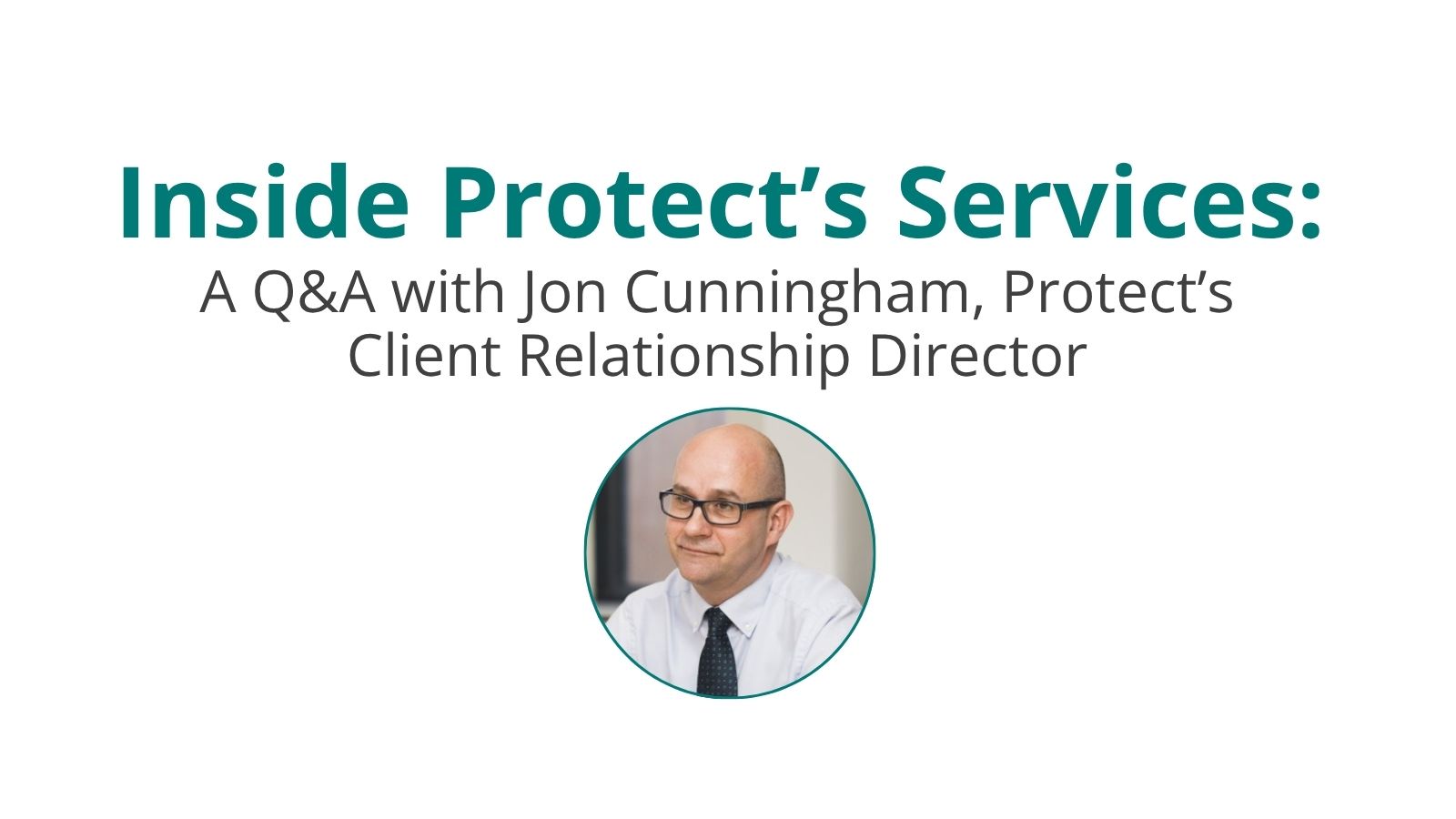
Inside Protect’s Services

Building an effective whistleblowing framework can be complex. We asked Jon, our Client Relationship Director, who has spent 14 years working closely with organisations at Protect (it’s fair to say he knows this space inside out) to share his insights on what organisations can expect when working with Protect, the common challenges they face, and the real impact of getting whistleblowing right.


What does working with Protect look like in practice?

Working with Protect is about more than just policies – it’s about building a complete, effective system.

We support organisations through training at all levels, expert advice, and practical tools to strengthen their approach. A key part of this is helping organisations look at the full picture: leadership, communication, staff awareness, protection, investigation processes, and trust.

Article content

What is included in Protect’s membership, and why is it valuable?

Our membership is built around creating a community of organisations committed to best practice.

Members benefit from regular forums and drop-in sessions. Alongside this, members have access to training and our Whistleblowing Benchmark, giving them both the insight and practical tools to continuously improve. We host events throughout the year, and our members are the first to hear about any new exciting opportunities we have lined up.

We see our work as an ongoing partnership. We stay in touch with organisations to understand how they’re progressing, what challenges they’re facing, and how we can continue to support them. Whether through follow-ups, additional training, or further consultancy, we’re there to help organisations keep improving.

Our community is a welcome space, they have taken our member’s pledge to bettering their workplaces, and we are committed to supporting them in every step on that journey.


Tell us more about Member Forums, what role do they play in driving change?

The forums are one of the most powerful elements of membership.

They bring together people facing similar challenges and allow them to share real-world experiences. That peer learning is incredibly valuable – organisations often realise they’re not alone and can take away practical ideas they can implement straight away. These sessions operate under Chatham House Rule, creating a safe space to share challenges and solutions openly.

It’s not just about hearing from Protect – it’s about learning from each other.


What changes do you see in these organisations that engage deeply with your services?

Organisations that fully engage with our support tend to develop much stronger, more mature whistleblowing frameworks.

They move beyond a focus on policy alone and start to prioritise culture – engaging staff, training managers, involving senior leadership, and improving communication. Importantly, they also focus on feedback loops, ensuring whistleblowers feel heard and understand the value of speaking up.

The result is not just better processes, but a more open and trusted environment.


Tell us where you have seen Protect’s impact directly?

A powerful example is our work supporting Cambridgeshire County Council during its governance reforms. When new leadership came in, there was already a whistleblowing policy in place – but staff lacked confidence in it and rarely used it. With Protect’s support, the council focused on rebuilding trust and embedding whistleblowing into its organisational culture, not just its procedures.

This shift helped create an environment where people felt safe to speak up, and whistleblowing started to be seen as a sign of a healthy organisation rather than something risky. As a result, more concerns were raised, governance improved, and issues were picked up earlier – showing how the right support and a focus on culture can really change how organisations respond to problems.


What are the typical concerns organisations come to Protect with?

Organisations come to us for a variety of reasons. Some have experienced a whistleblowing concern that perhaps wasn’t handled as well as it could have been. Others aren’t sure whether their current framework is truly fit for purpose, and some are already confident but want to keep improving.

Our role is to meet organisations where they are. We help identify gaps, provide a roadmap for improvement, and support them through a combination of training, consultancy, and our diagnostic tool, the Whistleblowing Benchmark.


What are the most common gaps you see in whistleblowing frameworks?

While every organisation is different, engagement is often the biggest gap. Many organisations have policies in place, but struggle to bring them to life. Building awareness, maintaining trust, and ensuring managers feel confident handling concerns requires ongoing effort.

Article content

What makes Protect different from other providers?

What sets Protect apart is our unique perspective. We’re not just a consultancy or training provider. Our work is informed by over 30 years of experience, including supporting more than 60,000 whistleblowers through our advice line, influencing whistleblowing legislation directly in parliament and a breadth of research work.

This means we bring both the organisational, whistleblower and legal perspective – giving us a deep, balanced understanding of what really works.


Why is this work so important?

At its core, effective whistleblowing is about preventing harm.

When people feel safe to speak up, organisations are better able to identify issues early, respond appropriately, and build trust internally and externally.

That’s why this work matters – and why we’re committed to supporting organisations every step of the way.


Get in touch with our team to find out how we can help you: Whistleblowing Support for Employers – Protect – Speak up stop harm

All Blog Posts

Wrongdoing ignored and those who speak up victimised at alarming levels

Protect, the UK’s leading whistleblowing charity, which provides free legal advice to whistleblowers, says that employers are still ignoring serious concerns raised by those in the workplace.

Publishing its impact report on the state of whistleblowing in the UK in 2025, the charity found:

  • Thirty‑eight per cent of whistleblowers calling Protect for advice say that after raising concerns about wrongdoing, malpractice or risk in their workplace, the issues were ignored.
  • Seven in ten (71%) of whistleblowers who contact the charity for advice say they have been dismissed, victimised, or have resigned from their job after blowing the whistle.
  • Despite a focus on the issue, concerns about harassment and discrimination in the workplace remain stubbornly high – at 14% of calls.
  • Protect’s services are needed more than ever – the charity reported an 8% increase in new cases in 2025 compared with 2024.


Elizabeth Gardiner, Joint Chief Executive, said:

“For too long whistleblowers have been let down by a system that is far too passive in holding employers to account when they retaliate against staff who speak up about wrongdoing. More worrying is the lack of accountability for employers who ignore the serious public interest issues raised by their own staff.

“The impact of ignoring whistleblowers ripples out from harm to the individual to damage the employer, to costs the taxpayer.  So many scandals and disasters— from Post Office/Horizon IT to the Lucy Letby case—could have been prevented had staff been listened to when they identified problems at an earlier stage.  The Government’s forthcoming review of whistleblowing needs to address failings in accountability and restore whistleblowers’ and the wider public’s confidence that those who speak up to stop harm are heard and protected.”

Protect is calling on the Government to improve protection for whistleblowers by:

  • Creating a legal requirement for all employers to investigate whistleblowing concerns raised by staff.
  • Extending the types of wrongdoing covered by whistleblowing law to include waste of public funds and abuse of authority.

Expanding whistleblowing protection to cover all those in the workplace including trustees, job applicants and self‑employed contractors.

ENDS

Notes to Editors:
For more information, please contact:
press@protect-advice.org.uk
07399 128124

Recent Posts

Get ahead of the curve for 2026

Non-financial misconduct focus 

From 1 September 2026, employers in Financial Conduct Authority (FCA)-regulated firms will face clearer – and stricter – rules on non-financial misconduct (NFM). These rules will cover how regulated firms should respond to incidents such as bullying, harassment, and retaliation against whistleblowers, which until now have been handled inconsistently. 

New FCA guidance- issued alongside the new rules-will apply to most staff across all authorised firms, not just those in front-line regulated roles. The focus will be on the impact and context of behaviour, including conduct linked to work events, professional relationships, or misuse of power. Managers will be expected to take an active role in preventing and addressing misconduct, and failing to do so could itself breach FCA rules. 

Non-financial misconduct will also carry more weight in Fit and Proper tests for employees and senior personnel. In practice, employers should expect more complex and formal investigations, with less room to ignore or quietly manage issues; closer working relationships between HR, legal, and compliance teams when addressing NFM allegations; and greater overlap with whistleblowing processes, as more private disputes may become breaches of FCA regulations. 


Provision 29: Responsibilities of the Board 

From January 2026, Provision 29 of the UK Corporate Governance Code raises expectations around how organisations manage risk and internal controls. Boards will need to do more than just say the right frameworks are in place – they’ll be expected to actively monitor them throughout the year and clearly explain how effective they are, and how any weaknesses have been addressed. In practice, this means moving beyond box-ticking towards a more joined-up approach to risk, where controls are tested, issues are acted on, and responsibility is clear across the organisation. For employers, getting this right can strengthen decision-making, improve transparency, and give regulators, investors and staff greater confidence that risks are being properly managed.  

Effective whistleblowing systems are key to managing risk, but does your Board know if your whistleblowing arrangements are working?  

Protect’s benchmark allows you to consider all aspects of your whistleblowing system, and our independent audit can give your Board confidence that you have a roadmap for improvement.  


Whistleblowing standards 

Last year, we ran a whistleblowing standards project with organisations from a single sector. Participants shared information with Protect on the types of concerns raised, reporting volumes, anonymity rates and other key data, which then analysed and benchmarked against other organisations from their sector. Each organisation received a confidential, anonymised report showing how their arrangements compared with others in the sector. We’ll be running this project again this year, and if you’re interested in discussing a similar exercise for your sector, we’d be happy to meet to explore. Get in touch. 


Want whistleblowing support specific to your sector? 

We’ve launched a new set of sector-specific whistleblowing pages to help employers better understand and manage whistleblowing concerns in their own industries. These pages can help you identify if you are in need of support. By breaking whistleblowing down by sector, we aim to make it easier for employers to build effective speak-up arrangements, handle disclosures confidently, and create workplaces where people feel safe to raise concerns early.  


Is your workplace ready for new waves of employees? 

As we move into 2026, understanding how different generations experience whistleblowing is more important than ever. Our Attitudes to Whistleblowing Report shows that people’s views on speaking up at work can vary widely depending on age, expectations and workplace culture. By better appreciating these differences, employers can build more welcoming, inclusive environments where everyone – whether just starting their career or with decades of experience – feels confident and supported to raise concerns.  


Training 

We’ve got more training lined up in 2026 to help organisations build stronger, fairer whistleblowing systems.  

  • First up on 5 March is our Whistleblowing Essentials session – a practical introduction to best practice for organisations. 
  • Then on 19 March, join our Financial Services Whistleblowers’ Champion Masterclass, designed for those working in or with regulated financial firms.  
  • Following that, on 30 April, we’re running Investigating a Whistleblowing Concern, focused on how to handle and investigate reports effectively and confidently.  

All sessions are online and delivered by our expert team, bringing decades of whistleblowing experience straight to your screen. 

All Blog Posts

2026 Whistleblowing calendar

Legal Interventions and Regulator Work 2026

In 2026 the joint cases of Rice v Wicked Vision Ltd and Barton Turns v Treadwell will be heard in the Supreme Court. The saga continues… the case raises complex points – as it will examine whether claiming and getting compensation for dismissal via the easier detriment route is open to employees. Protect was given permission to intervene as an independent third party by the Court of Appeal to provide the court with the policy background and evidence from our work with whistleblowers and employers on the ‘real-world’ consequences of their interpretation of the law. We hope to be able to be part of the Supreme Court hearing too.


The Hillsborough Bill

The Public Office (Accountability) Bill, more commonly known as the Hillsborough Bill, is likely to become law by the Spring of 2026.

The intention behind the bill is to end the culture of coverups and the closing of ranks from public officials when it came to major scandals such as Grenfell Tower fire, the Infected Blood Scandal and the Post Office/Horizon scandal.

This is a law that will introduce a Duty of Candour on all public officials, create a new legal offence for misleading the public and provide greater legal aid for bereaved families in inquests. Protect is supportive of these proposals and the bill as a whole.

However, Protect believes that for the bill to be effective, it requires the strengthening of protections for those that come forward under the new Duty of Candour. That’s why we’ve called for the bill to include; a duty on all public sector employers to take reasonable steps to investigate the concerns raised by whistleblowers, an independent commissioner for civil servants to take responsibility of incoming whistleblowing concerns, a requirement that public sector bodies are under a duty to prevent victimisation of whistleblowers, a new offence for retaliating or impeding a whistleblower, and greater legal aid for whistleblowers.

We’re happy to say that MPs of all parties have pushed for whistleblowing to be part of the legislation at all stages of the bill. So far, the Government have been reluctant to accept major amendments from outside groups. As such, we are working with MPs and Lords to put together a strategy in the coming months to ensure that whistleblowing remains a prominent feature of the debate. As the Bill completes its journey through Parliament, we are focussed on making this law is as effective as possible by ensuring those that come forward are protected.


Implementing the Employment Rights Act 2025

The Employment Rights Act 2025 will bring in a number of changes that matter for whistleblowers and anyone raising concerns about sexual harassment at work. From April 2026, whistleblowing protections will clearly cover sexual harassment. While this was already possible through case law, spelling it out in the law itself makes the protection easier to understand and use.

By October 2026, the Government expects to ban the routine use of NDAs in sexual harassment cases. NDAs will only be allowed if both sides genuinely agree to them, helping to stop people being silenced after raising concerns. Guidance on how this will work in practice is expected following a consultation in early 2026.

Also from October 2026, employers will be under a new duty to take all reasonable steps to prevent sexual harassment, including harassment by third parties. Having strong whistleblowing arrangements and a culture where people feel safe to speak up will be key – not just meeting the law, but to tackling problems early and avoiding harm in the first place.


Cases to watch

The Post Office Horizon inquiry is expected to conclude early in 2026, Volume 2 will cover why the scandal occurred- looking at the organisational failures that lead to the largest miscarriage of justice in UK legal history. The inquiries conclusion is likely to be  stark reminder of what can go wrong when concerns are ignored as Protect highlighted in research from 2025 – and why strong whistleblowing protections and cultures that genuinely listen and act are vital.

The Thirlwall Inquiry, examining the events that lead to the murders committed by Lucy Letby, is also expected to be published in early 2026. Whistleblowing is likely to be a major part of the inquires findings chronicling how staff raised concerns about Lucy Letby but ultimately were ignored by senior managers. The evidence so far underlines the importance of creating workplaces where people feel safe to speak up and are taken seriously when they do, Sybille Raphael, legal director of Protect, said NHS staff felt raising concerns was “like throwing a pebble in a dark hole”, adding: “It’s completely pointless.” “Instead of being thanked for doing what they should do, which is raising a concern, they are being punished for it, they are being victimised.”

The inquiry is a powerful reminder that whistleblowing isn’t just a policy issue – it’s about preventing harm and saving lives.

All Blog Posts

The UK’s new anti-corruption strategy: welcome signals, but Insufficient action

The government has finally launched its long-awaited anti-corruption strategy – more than two years in the making. Setting out the UK’s approach to tackling corruption it explicitly acknowledges the serious threat it poses to our national security and political system. Protect attended the launch as a key stakeholder, alongside other organisations working at the forefront of anti-corruption efforts. 

The strategy recognises two vital elements that hold the key to reforming the UK’s whistleblowing framework. The first is that whistleblowers are the pipeline through which information on corruption flows. The second is that the UK’s whistleblowing system is broken and requires reform. Despite this recognition, the strategy offers very little by way of concrete action for the protection of whistleblowers and, unless this is remedied, we believe the UK’s ability to detect and expose corruption will be severely limited.  

Recognition, but no roadmap 

While acknowledging that whistleblowers are “one of the most effective assets in identifying wrongdoing”, it sidelines the central questions of how to improve protection when they speak up, and how to prevent retaliation in the first place.  

There are no milestones in the strategy, or any commitments to whistleblower safeguards, only broad promises to “explore” reforms in 2027. It largely passes responsibility to the upcoming Fisher KC review, expected in 2026, and indicates it will “consider the findings” which will include “incentivisation of whistleblowers in economic reform”.  Incentives are measures to encourage more disclosures, but there is no detail on any safeguards that should be included. 

The lack of urgency to examine how the framework can better protect whistleblowers is a critical gap. More than two thirds of the whistleblowers that call our legal Advice Line tell us they face serious retaliation that affects their careers, finances and wellbeing. Beyond the personal impact, this creates a chilling factor that prevents many others from speaking out.  

There were, however, some encouraging signs of the need for protection coming from the Serious Fraud Office (SFO). Emma Luxton, the SFO’s Director of Operations, stressed during the strategy’s launch that it is “important to put in place safeguards…we want to see some structure there to prevent retaliation”. While this recognition is important, it requires firm commitments by additional stakeholders – from government departments to regulators –  translating into meaningful protection. 

Protect’s suggested safeguards 

To ensure that whistleblowers are protected, and to create a pipeline of information on corruption, we believe three reforms are essential. 

  • The first is that employers who punish individuals for speaking out will face real sanctions, creating actual deterrence. In the U.S, the Securities and Exchange Commission (SEC) regularly takes enforcement action against organisations that retaliate against whistleblowers. For example, in  2024 the SEC brought 11 actions against organisations and individuals who tried to impede whistleblowers from reporting to the regulator.  This included a $500,000 civil penalty against GQG Partners LLC using non-disclosure agreements to prevent disclosure to the SEC. The UK strategy should adopt similar robust enforcement powers, and they be along-side incentive programs to encourage whistleblowing disclosures.
  • The second is that whistleblowers who do speak out receive appropriate support. Those who face retaliation often find themselves navigating complex legal processes against better-resourced employers. All enforcement and investigatory bodies should have a clear duty of care, including support for employment tribunal claims and SLAPP-related legal action.
  • The third is that if incentives are being considered, they must be governed by transparent, accessible and fair processes. International experience shows that only a small proportion of whistleblowers ever receive rewards. To avoid unnecessary complexity, the Government should publish clear criteria for, e.g. eligibility and for calculating any awards. 


The government’s strategy signals an important shift: whistleblowing is no longer seen simply as a conflict at work, an HR matter, but as part of the national effort to restore integrity, accountability and trust. The next essential step is to build a system that keeps whistleblowers safe enough to speak up, so that corruption can be uncovered and those who speak out are properly protected. 

All Blog Posts

Failure to Back Whistleblowers Undermines New Anti-Corruption Strategy  

Protect reacts to the Government’s released Anti-Corruption Strategy and the decision to defer action on whistleblowing incentives (pending the Fisher KC review into fraud, which is due at the end of the year) and to consider whistleblowing protection in 2027.  

Whistleblowing is fundamental to the UK’s ability to prevent, detect and respond to corruption. To ensure whistleblowers can speak up, we need to see three key reforms: 

  1. Punishment for those who retaliate against whistleblowers
  2. Protection and remedies for whistleblowers facing victimisation, and 
  3. Any incentive scheme for whistleblowers needs to have clear, transparent processes  

Andrew Pepper-Parsons, Director of Policy and Communications, Protect, says:  

“It is disappointing that the Government have not seized the opportunity of a new Anti-Corruption Strategy to commit to better whistleblowing protection. Whistleblowing is vital in the fight against corruption; whistleblowers are the early warning system of wrongdoing who deliver key information to regulators and law enforcement bodies.  

“Protect’s Advice Line shows that more than two thirds of whistleblowers report some form of retaliation.  Without action to reduce this level of victimisation, staff will be discouraged from speaking up and many organisations will continue to treat whistleblowers as a risk instead of recognising their crucial role in preventing wrongdoing.  

We need to see employers sanctioned where they are found to retaliate against a whistleblower.  Regulators must also have a duty of care towards whistleblowers who often provide information at great risk to themselves.  

While whistleblower rewards may increase the flow of information to regulators, the effectiveness of any new scheme needs to be monitored.  Transparency around how whistleblowing concerns are handled is key. Any whistleblower incentive scheme should publish accessible guidance and real-world examples of how rewards are calculated and awarded, to ensure consistency and fairness.” 

ENDS

Notes to Editors:
For more information, please contact:
Mark Ellis, Head of Communications, Protect
press@protect-advice.org.uk
07399 128124

Recent Posts

Nicol v World Travel and Tourism Council [2024] EAT 42

Mr Nicol had raised concerns to HR consultants about his CEO’s managerial style . The CEO was informed that concerns had been raised about her but was not told about their substance. Shortly afterwards, Mr Nicol was dismissed. Mr Nicol lost his s.103A dismissal claim because the ET found that the decision-maker—the CEO—had not been aware of the substance of the protected disclosure.

Mr Nicol appealed on the grounds that as long as a protected disclosure had been made to his employer (the HR consultants), and the decision-maker (the CEO) knew that a disclosure had been made, then the decision-maker did not need to know the substance of the disclosure to be liable for the retaliation.

On appeal, the EAT upheld the ET’s decision. It held that employers must have at least some knowledge about the substance of the disclosure to be liable for unfair dismissal arising from it. Mere awareness that a concern had been raised is not sufficient to establish causation.

Protect’s Comment: Proving that whistleblowing is the principal reason for a dismissal is an uphill battle for claimants. The first obstacle can indeed be knowledge: some employers will try to avoid liability by claiming or keeping themselves in ignorance of the substance of the disclosure. Though the EAT asserts in its judgement that the case of Jhuti  should provide adequate safeguards against such a scenario, as Tribunals were directed to “penetrate through the invention” of feigned or deliberate ignorance, this may be circumvented.s. For instance, it is easy to imagine a scenario where a decision-maker dismisses a whistleblower without knowing about or caring for the substance of their disclosure.

All Case Studies

Wicked Vision Ltd v Mr I Rice [2024] EAT 29 and Ms G Treadwell v Barton Turns Development Ltd

These two cases are about the same legal point. The ERA provides for two different causes of action for dismissal (s103A) and detriment (s47B). A s.47B detriment claim cannot be used when the detriment in question amounts to a dismissal as there is a different cause of action for dismissal claims.  Only an employee can be dismissed so a worker who loses their job needs to bring a s47B detriment claim.  However, since Osipov, employees have been able to bring a s.47B detriment claim for the decision to dismiss taken by a co-worker, in addition to (or instead of) a s.103A dismissal claim.

Mr Rice and Ms Treadwell were both dismissed after raising concerns. Quoting Osipov, both ran a s.47B detriment claim for having been subjected to the detriment of a co-worker’s decision to dismiss them, for which the employer was vicariously liable.

In Wicked Vision, the EAT accepted that a worker can hold the employer vicariously liable for detriments by an individual co-worker under s.47B(1B). However, the EAT then said that where the detriment amounts to an unfair dismissal and where the employee can bring a dismissal claim under s.103A, they cannot bring a detriment claim for the decision to dismiss under  s.47B. Osipov was significantly restricted: “dismissal as detriment” claims could only be brought in cases where liability under s.103A was not possible. In Osipov, a s.103A claim was not possible because the company was bankrupt. In Wicked Vision, as the company and the co-worker were essentially the same (the decision-maker was the owner of the company) and as the company was not insolvent, Mr Rice was able to bring a s.103A claim and therefore could not also bring a s.47B claim for the decision to dismiss.

In Treadwell, a few months later, a different EAT went the other way and ruled against the employer. The judge stated that the EAT was bound by Osipov: employers can be held vicariously liable for the detriment of dismissal under s.47B detriment claims. The judge also held that he was not obliged to consider Wicked Vision as a binding precedent or even a persuasive authority. It is possible for an employee to bring a s.47B claim against an individual coworker for subjecting them to the detriment of dismissal, and to bring a claim of vicarious liability for that act against the employer. All that s.47B excludes is a claim against the employer in respect of its own act of dismissal.

Both cases have been joined and will be heard by the Court of Appeal in early 2025. Protect has been granted permission to intervene.

Protect’s Comment: We are concerned that the Wicked Vision approach to Osipov will further complicate the path to compensation for whistleblowing victimisation, which is already a legal minefield. The legal test is more stringent in dismissal cases (where the protected disclosure must be proven to be the principal reason for the dismissal) than in detriment cases (where the disclosure needs only to have materially influenced the employer’s treatment).Moreover, compensation for injury to feelings is only available in detriment claims. Workers can use the less stringent test under s.47B to claim for the detriment of dismissal, but the Wicked Vision approach would create an absurd situation where employees are unable to use the less stringent test and consequently have a lower level of protection for whistleblowing-related dismissal than workers in the exact same position.

All Case Studies

Mr Declan Durey v South Central Ambulance Service NHS Foundation Trust

This week, MPs have had their first opportunity to vote on and debate the Public Office (Accountability) Bill – better known as the Hillsborough Law. 

Championed by the Hillsborough families and campaigners it’s being presented as a way to prevent future state cover-ups such as the one they faced after the Hillsborough disaster. 

It would introduce a new duty on public authorities and public officials to act with candour, transparency and frankness; a new offence of misleading the public; and more broadly makes provisions to improve public inquiries and investigations. We believe that for this bill to be truly effective, it needs to guarantee stronger protections for the whistleblowers that come forward.  

Whistleblowing firmly on the agenda
We were pleased to see numerous MPs from across the political spectrum including  Labour’s David Baines and the Lib Dem’s Jess Brown-Fuller and Tessa Munt raise the issue of whistleblowing. They voiced calls for the bill to explicitly recognise the role of whistleblowers, to enhance whistleblowing protections on disclosures made under the new duty of candour, and to bring in a statutory duty on organisations to foster a speak-up culture. It’s a positive reflection of the state of whistleblowing in the Westminster agenda to hear these contributions and we are excited to engage with MPs and their officials on these issues as the bill progresses.
 

Protect’s comment: Protect welcomes this decision, as it would have been deeply concerning to have such an important remedy taken away. It is crucial that whistleblowers can get compensation for the enormous emotional and psychological harm that can arise from retaliation for whistleblowing. This is not just to remedy injustice to the individual whistleblower who has been punished for “having done the right thing”, but also because of the deterrent effect that unchecked whistleblower victimisation has on those that witness it.

All Case Studies

Press statement: New HMRC whistleblowing rewards scheme

Responding to the government’s announcement in today’s budget regarding a new HMRC whistleblower incentive scheme,

Elizabeth Gardiner, Joint-Chief Executive at Protect, said: 

“We support changes that contribute to the fight against tax fraud – anything that improves the ability of regulators to take action against wrongdoing is in the public interest.  However, rewards are no substitute for a comprehensive whistleblowing framework.

There is no shortage of whistleblowers currently reporting concerns to HMRC (over 14,000 in 2022-23), despite the serious personal and professional risks they face. Few whistleblowers do so seeking or expecting a reward.

Transparency around the performance of the scheme is essential. HMRC should publish accessible guidance and real-world examples of how rewards are calculated and awarded, to ensure consistency and fairness.  They need to set out how HMRC will protect and support those who come forward, including those who do not receive payouts. The effectiveness of the scheme in improving action against tax fraud needs to be monitored.

Make no mistake, rewards may support better enforcement, but experience in the US and elsewhere shows that only a very tiny minority of whistleblowers are likely to receive anything at all.  A reward scheme needs to go hand in hand with improvements to the wider system that empowers and safeguards those who speak up.”

ENDS

Notes to Editors:
For more information, please contact:
Mark Ellis, Head of Communications, Protect
press@protect-advice.org.uk
07399 128124

Recent Posts